01
scDrugPerturb-Bench preprint
The scDrugPerturb-Bench manuscript defines mechanism-aware evaluation tasks and reporting standards for single-cell drug response prediction.
CompletedOur vision is to build an intelligent virtual cell that can reason over biological mechanisms, simulate cellular responses and help solve the most complex challenges in biopharmaceutical discovery and development.

We are building from open, reproducible perturbation resources toward models that predict intervention responses, connect molecular mechanisms to phenotypes and support therapeutic discovery.
The scDrugPerturb-Bench manuscript defines mechanism-aware evaluation tasks and reporting standards for single-cell drug response prediction.
CompletedVersion 1 of our curated perturbation dataset is now available, with ongoing maintenance and updates as the resource continues to grow.
v1 releasedVersioned genetic-intervention datasets with biological context, provenance, evidence and reproducible splits.
In progressGeneral-purpose models that learn transferable representations of cell state across datasets, conditions and biological contexts.
In progressMechanism-aware models for predicting cellular response across drug and gene perturbations, spanning compounds, doses, cell states and experimental systems.
In progressVirtual-cell applications for drug discovery tasks such as compound retrieval, target discovery, response prediction and therapeutic prioritization.
Long-termUnlike benchmarks built only from expression matrices, scDrugPerturb-Bench links each evaluation case to a biological conclusion extracted from its source paper. It tests whether a model recovers the direction, magnitude and specificity of drug response beyond expression similarity.
In HUES8 pancreatic progenitors, 0.5 µM latrunculin A for 5 days upregulates NEUROG3 versus untreated cells.
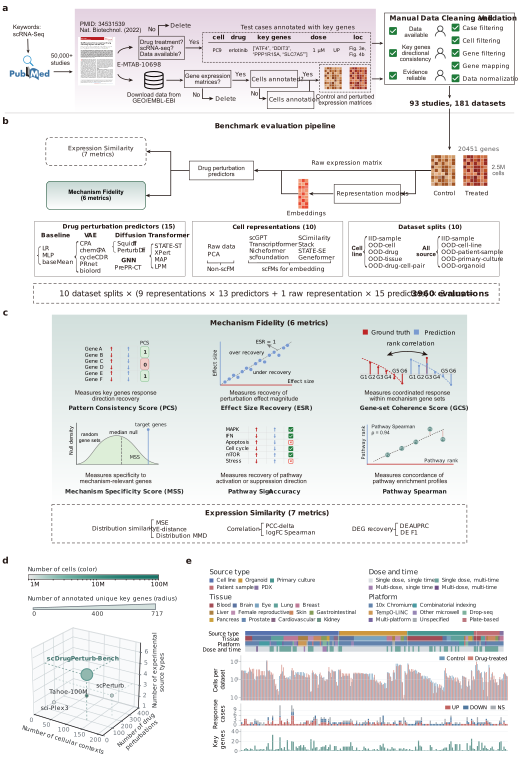
Built for mechanism-aware benchmarking across compounds and biological contexts.
Turn scientific papers and public single-cell datasets into evidence-linked perturbation metadata and standardized h5ad files.
One processing standard for heterogeneous public single-cell data, from source files to analysis-ready AnnData.
Follow Simucella as datasets, models and evaluation resources become available.